
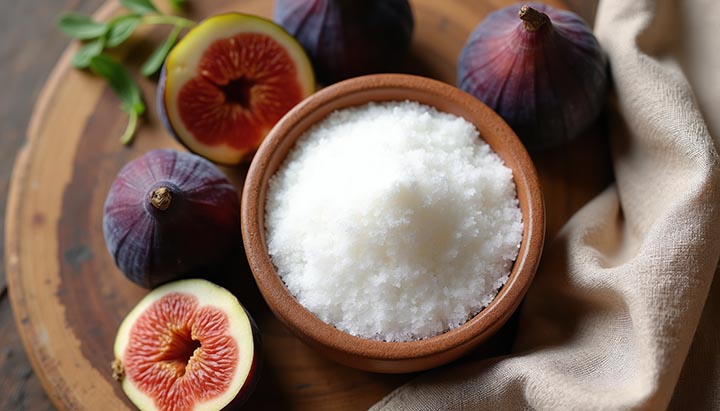
Allulose has the same atoms as fructose, arranged in a slightly different shape. That small difference changes how your body handles it.
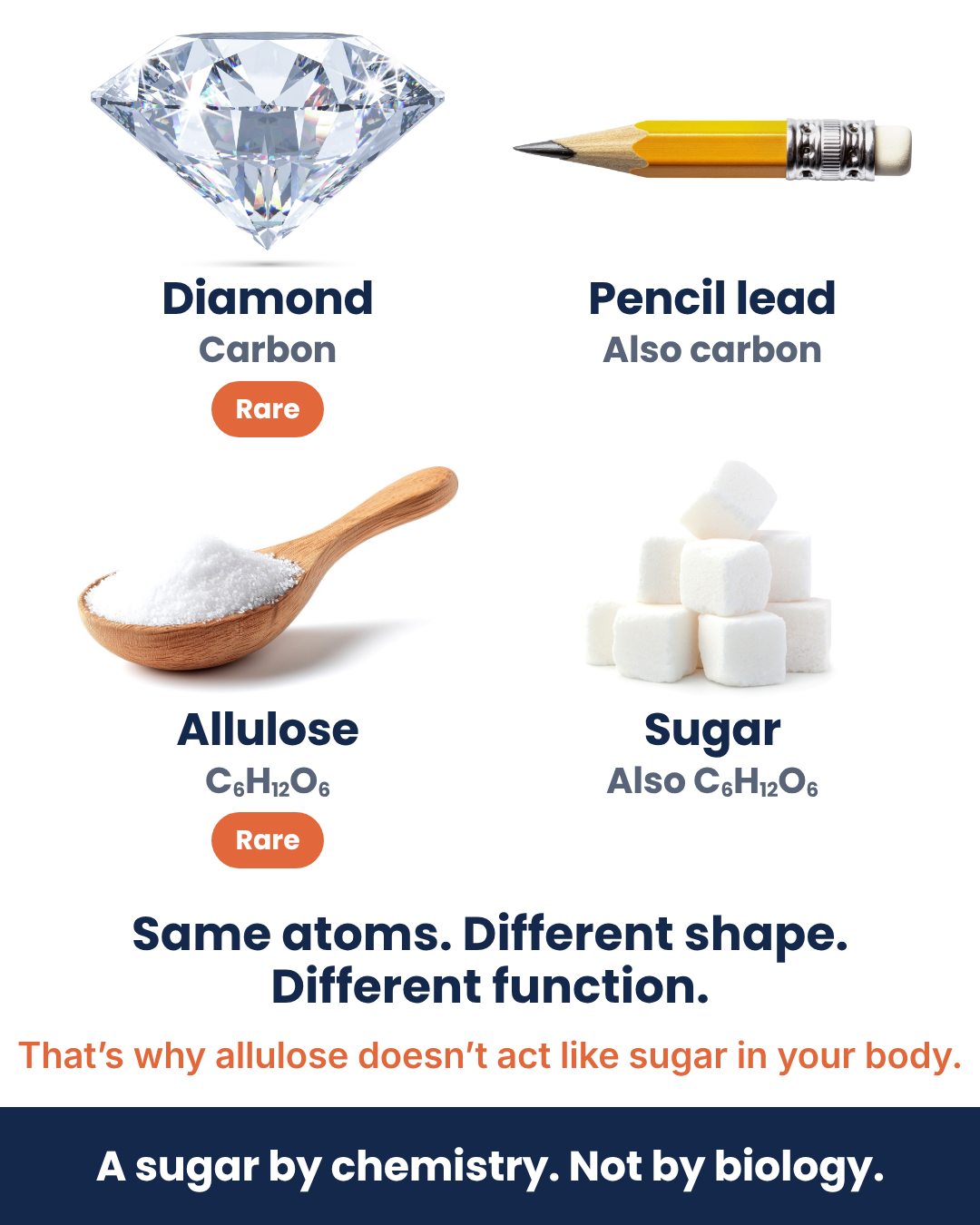
Same elements, different shape
Diamonds and the graphite in pencils are both made of carbon. The atoms are arranged differently, so one is the hardest natural material and the other is soft enough to write with.
Allulose and fructose (the sugar found in fruit) work the same way. They are made of the exact same atoms. The only difference is one small flip in how those atoms are arranged.
Why that flip matters
Your body breaks down most sugar using targeted enzymes whose shape dictates their function like a key in a lock. Allulose’s shape doesn’t fit, so it's largely excreted from your body without being used.
The result
Allulose has far fewer calories than sucrose (table sugar) and has a negligible impact on blood sugar and insulin.
What is allulose?
Allulose is a rare sugar that tastes a lot like table sugar. It is about 70% as sweet as table sugar and has a similar texture, so it works well in baked goods, drinks and other foods.
A monosaccharide, or simple sugar, allulose is not metabolized by the body, so it is nearly calorie-free. Allulose is called a “rare sugar” because it is found in nature only in small amounts, in few foods like figs, raisins and maple syrup. The allulose used in foods today is made from plant sources, such as corn or sugar beets, using enzymes to convert fructose to allulose. Allulose is added to a wide range of foods such as cereals, snack bars, ice cream, jams, beverages, and baked goods.
Why is allulose different than sugar and what does the FDA say?
FDA recognizes the difference: FDA puts allulose in a small group of sugars that are “metabolized differently than traditional sugars.” According to FDA, these sugars provide fewer calories than table sugar, are not linked to cavities, and may lead to lower blood sugar and insulin levels after a meal.
In 2020, FDA issued final guidance about how allulose can be declared on food labels. FDA said that it would not take action if companies leave allulose out of the “Total Sugars” and “Added Sugars” amounts on the Nutrition Facts label because the body does not process allulose the way it does other carbohydrate sweeteners.
How to find allulose on a food label
Allulose is always listed in the ingredient list. On the Nutrition Facts label, it is counted in Total Carbohydrate. Under FDA’s final guidance, it might not be counted in Total Sugars or Added Sugars.
Sources
- Amna Ahmed, Tauseef A Khan, D Dan Ramdath, Cyril W C Kendall, John L Sievenpiper, Rare sugars and their health effects in humans: a systematic review and narrative synthesis of the evidence from human trials, Nutrition Reviews, Volume 80, Issue 2, February 2022, Pages 255–270, https://doi.org/10.1093/nutrit/nuab012
- Noronha JC, Braunstein CR, Glenn AJ, et al. The effect of small doses of fructose and allulose on postprandial glucose metabolism in type 2 diabetes: a double-blind, randomized, controlled, acute feeding, equivalence trial. Diabetes Obes Metab. 2018;20:2361–2370.
- Han S, Rajitha K, Park S, Lim J, Jung H-Y, Kim J and Kim D (2025) Unveiling the impact of allulose on oral microbiota and biofilm formation via a cariogenic potential assessment platform. Front. Cell. Infect. Microbiol. 15:1670139. doi: 10.3389/fcimb.2025.1670139 https://pubmed.ncbi.nlm.nih.gov/41189707/
- FDA: Sugars That Are Metabolized Differently Than Traditional Sugars
- FDA: Guidance for Industry: The Declaration of Allulose and Calories from Allulose on Nutrition and Supplement Facts Labels