Dietary Guidelines 2020-25 Scientific Report Published

Posted by & filed under Statements.

Among other items, today’s published Scientific Report from the Dietary Guidelines Committee from the U.S. Department of Health and Human Services (HHS) and the U.S. Department of Agriculture (USDA) included sections on added sugars, low and no calorie sweeteners (LNCS) and fiber intake. As a basis for the guidelines to be published later in the year, the purpose of the scientific report is to summarize and review evidence and recommendations, which are then submitted to USDA and HHS.

Reducing Added Sugars

  • Adverse Effects: Recent systematic reviews provide additional supporting evidence of the adverse effects of added sugars, particularly sugar-sweetened beverages. Reducing the amount of added sugars in the diet through consumer behavior changes, changes in how food is produced and sold, and shifts in food policies are achievable objectives that could improve population health.
  • Reduction Goal: An individual’s dietary pattern of getting less than 6 percent of energy from added sugars is more consistent as nutritionally adequate while avoiding excess energy intake compared with less than 10 percent of energy from added sugars.

The Use of Low and No Calorie Sweeteners

  • Helpful in Weight Management: Although there is limited evidence, low and no calorie sweetened beverages may be a useful aid in weight management in adults.
  • Useful in Blood Glucose Management: Helpful for Americans suffering from diabetes, LNCS do not raise blood glucose or insulin levels, and when used to replace sugar, can help lower carbohydrate intake.

Increasing Fiber

  • Nutrient of Concern: Fiber is a nutrient of public health concern,as most Americans are only getting about half the recommended daily amount of fiber.

About the Dietary Guidelines

Since 1980, the Dietary Guidelines for Americans (Dietary Guidelines) has been at the core of Federal nutrition programs and valuable resource for health professionals nationwide. Providing food-based recommendations to promote health, help prevent diet-related chronic diseases, and meet nutrient needs, they are published jointly by the U.S. Departments of Agriculture (USDA) and Health and Human Services (HHS) every five years.

The current edition — the 2015-2020 Dietary Guidelines — is the 8th edition until the 2020-2025 Dietary Guidelines is released which is planned to include more comprehensive guidance for infants and toddlers and for pregnant women, with plans to take a life stage approach. To learn more about the Dietary Guidelines and work under way, please go to DietaryGuidelines.gov, where you also can sign up for email updates.


How low calorie sweeteners can help you reduce added sugars


Variations in Marginal Taste Preference Perception by Body Mass Index Classification: A Randomized Controlled Trial

scale

Posted by & filed under Health Care Professionals, Health Professionals, Research Summaries, Sweet Taste.


TITLE:  Variations in Marginal Taste Preference Perception by Body Mass Index Classification: A Randomized Controlled Trial

CITATION & LINK: J Acad Nutr Diet. 2020; 120(1):45-52

AUTHORS: Aaron C. Miller, Linnea A. Polgreen, Elena M. Segre, Philip M. Polgreen

REVIEWER: Robyn Flipse, MS, MA, RDN

Objective

  • To model taste perceptions in a longitudinal or time-series fashion across the number of samples consumed
  • To determine if taste perceptions, in terms of the overall level and rate of decline, differ between normal-weight, overweight, and obese individuals
  • To analyze what effect, if any, the availability of nutritional information would have on taste perceptions

Background

  • Decisions about what and how much to consume are driven, in part, by individual taste perceptions.
  • Diminishing marginal taste perception is the decline in taste perception an individual experiences from consuming one additional unit of a given food.
  • Sensory-specific satiety is the relationship between perceived taste and the quantity of food consumed, most often used to measure the difference between pre- and post-eating quantity.
  • If the rate at which marginal taste perceptions diminish differs among normal-weight, overweight, and obese adults, the quantification of satisfaction from food may help explain why some people eat more than others and represent a new obesity risk factor or phenotype.

Methods

  • 290 adults between the ages 18-80 (80% female) were recruited; height and weight was measured with clothes and shoes on; BMI categories were defined using standard cutoffs.
  • Participants were randomized into two groups, “informed” and uninformed”, to observe the impact of nutritional information on taste perception.
    • Nutritional information for the chocolate samples was given to the “informed” group before the trial began.
  • Participants completed questionnaires on their taste perceptions with each piece of chocolate they consumed.  
    • A pretzel was provided at the start and end of the trail to determine if the changes in marginal taste perception for chocolate were driven by simple changes in hunger or sensory-specific satiety.
  • Time-series regression was used to model perceived taste changes while controlling for participant characteristics.

Findings

  • For all three BMI categories average taste perceptions decreased as sample number consumed increased.
  • Taste perceptions of normal-weight and overweight participants followed a nearly identical downward trend distinct from the curve of obese participants.
  • Obese participants reported consistently greater taste perceptions than nonobese participants and their taste perceptions decreased at a slower rate.
  • There was no evidence that nutrition information about the chocolate had any impact on a participant’s initial taste perception or rate of decline.
  • Diminishing taste perceptions were not solely the result of satiation as the pretzels consumed at the beginning of the study were reported to provide the same taste perception as pretzels consumed at the end, despite substantial declines in hunger.

Conclusions

  • A consistent association was identified between taste from food, in this case chocolate, and BMI.
  • There were no significant differences in taste perceptions between normal and overweight participants.
  • Obese participants had initial taste perceptions that were greater than nonobese participants and their taste perception declined at a more gradual rate than nonobese participants.
  • Providing nutritional information did not affect marginal taste perception in any BMI group.

Points to Consider

  • Research has shown that people are more likely to overeat when more types of food are offered.
  • The diminishing taste perceptions seen here may be due to a type of sensory boredom from repeated consumption of the same item, consistent with research on sensory-specific satiety. 
  • Other types of food (e.g. bitter or salty) may lead to different results.
  • Obese participants may need to consume a greater quantity of chocolate to experience a similar decline in taste perception to that of the nonobese participants.
  • Consuming chocolate (or other sweet foods) made with low-calorie sweeteners may help obese individuals achieve the same taste perception as lean and overweight individuals with the same quantity of food.

Robyn Flipse, MS, MA, RDN is a registered dietitian, cultural anthropologist and scientific advisor to the Calorie Control Council, whose 30+ year career includes maintaining a busy nutrition counseling practice, teaching food and nutrition courses at the university level, and authoring 2 popular diet books and numerous articles and blogs on health and fitness. Her ability to make sense out of confusing and sometimes controversial nutrition news has made her a frequent guest on major media outlets, including CNBC, FOX News and USA Today. Her passion is communicating practical nutrition information that empowers people to make the best food decisions they can in their everyday diets. Reach her on Twitter @EverydayRD and check out her blog The Everyday RD.


Obesity is associated with altered gene expression in human tastebuds

Posted by & filed under Health Care Professionals, Health Professionals, Obesity, Research Summaries, Sweet Taste.


TITLE: Obesity is associated with altered gene expression in human tastebuds

CITATION & LINK: IntJ Obes. 2019; 43:1475-1484

AUTHORS: Nicholas Archer, Jan Shaw, Maeva Cochet-Broch, et al (4)

REVIEWER: Robyn Flipse, MS, MA, RDN

Objective

  • To assess if there are underlying fundamental differences in the physiology of taste tissue between lean and obese individuals using analysis of gene expression in fungiform papillae.

Background

  • Taste and orosensory signalling are important in the cephalic phase response which impacts nutrient intake, satiety, and termination of food consumption.
  • Results of research comparing taste acuity in lean and obese individuals is mixed.
  • Both increased and decreased taste acuity has been found in those with obesity, or no association at all.
  • Studies in individuals before and after weight loss or bariatric surgery trend towards increased taste acuity following both.
  • Tastebuds are a collection of 50-100 taste cells and are composed of four different cell populations that have distinct functions or roles in taste perception.
    • Type I and III cells are associated with salt and sour taste, respectively
    • Type II cells are responsible for sweet, bitter, and umami taste detection

Methods

  • A cross-sectional design was used to analyze the transcriptomic profile (RNA-seq) of human fungiform taste papillae biopsied from 23 lean (mean BMI 22.1) and 13 obese (mean BMI37.2) Caucasian females (age 18-55) to identify differences in gene expression.
  • Fungiform taste papillae were quantified by counting the density of papillae on the tongue and biopsies were performed after a 2-hour morning fast.
  • Samples were separated into three equal groups accounting for obesity status, age group, and the doctor performing the biopsy.
  • RNA extract was converted into sequencing libraries using an input of 700 nanograms RNA per sample yielding 2.9 billion reads from the 36 participants.
  • Data analysis was completed in R (a language for statistical computing) using the R package for differential gene and transcript expression analysis of RNA-seq experiments.

Findings

  • Taste receptor genes were present in all samples and there was no difference observed in the density of fungiform taste papillae between the two groups.
  • Obesity status was the key factor influencing variability in gene expression between individuals, with no evidence for an age-related influence.
  • A total of 62 genes showed significantly different expression levels between the lean and obese participants with a consistent reduction in the expression of taste-related genes in the obese group.
    • The reduction in type II taste cell genes seen in the obese group is consistent with findings in animal studies.

Conclusions

• The gene expression of the human fungiform papillae is distinctly different between lean and obese people.
• The majority of the taste genes showing expression differences between lean and obese were type II taste cells.
• Type I and III taste cells showed similar expression level between lean and obese groups.

Points to Consider

  • Chronic inflammatory processes in obese individuals may account for some of the variability in fungiform papillae profiles seen in the lean and obese groups.
  • A reduction in type II taste cells in obese individuals may provide evidence of a link between taste and obesity.
  • Taste cells turnover every 7-24 days raising the possibility of preferentially influencing type II taste cells to reverse back to a lean profile.

Robyn Flipse, MS, MA, RDN is a registered dietitian, cultural anthropologist and scientific advisor to the Calorie Control Council, whose 30+ year career includes maintaining a busy nutrition counseling practice, teaching food and nutrition courses at the university level, and authoring 2 popular diet books and numerous articles and blogs on health and fitness. Her ability to make sense out of confusing and sometimes controversial nutrition news has made her a frequent guest on major media outlets, including CNBC, FOX News and USA Today. Her passion is communicating practical nutrition information that empowers people to make the best food decisions they can in their everyday diets. Reach her on Twitter @EverydayRD and check out her blog The Everyday RD.


Finding More Fiber-Rich Foods When Eating Out

Posted by & filed under Fiber.

Robyn Flipse, MS, MA, RDN

Research on the eating habits of Americans shows that our consumption of “foods away from home”* has been steadily rising since 1987. The amount of household food budgets spent on foods away from home surpassed the amount spent for “food at home” in 2010 when it reached 50.2 percent. (1) It has held that lead ever since.

Sources for the meals, snacks and beverages Americans eat away from home include quick-service, fast-casual and full-service restaurants; cafeterias, canteens and concessions; convenience stores, mobile food vendors and vending machines; and delis, bakeries, and drinking places. While a wide range of menu options are available in these outlets, the nutrient quality of the foods selected when eating in them traditionally has been higher in calories, fat, sodium and sugar than food from home. (1)

More recently, the quality of foods eaten away from home has become more similar to that of foods eaten at home due, in part, to the greater availability of healthy options on menus and the declining quality of the choices being served at home. (1)  Unfortunately, our intake of dietary fiber, an “underconsumed” nutrient according to the Dietary Guidelines for Americans 2015-2020, is still not at recommended levels in either setting. (2)

Wellness professionals can help their clients close this gap by guiding them to fiber rich options when eating away from home in addition to those they can readily find in the grocery store for meals prepared at home.

One way to add more fiber-rich foods away from home is by making Smart Swaps and Substitutions. For example, rather than ordering the most popular “combos” on the menu, consumers can swap out something in those combos for one more serving of  fruit, vegetable, whole grains, beans, nuts or seeds as illustrated in the chart. If they don’t see the swap they want on the menu, they should be encouraged to ask for it since the more requests a restaurant receives for an item the more likely it will be to provide it in the future. The establishment may also suggest an alternative. Additionally, consumers may find higher fiber options by looking for the “healthier choice” icon featured on many menus today.

SMART SWAPS AND SUBSTITUTIONS TO INCREASE FIBER WHEN EATING AWAY FROM HOME

BREAKFAST:

SUBSTITUTE THISFOR THIS
Fruit cup or sliced tomatoHome fried potatoes or hash browns
Half grapefruit or citrus sectionsOrange juice or grapefruit juice
Whole wheat toast or seeded rye toastWhite bread toast, English muffin or biscuit
Oatmeal with fruit or quinoa porridgeCream of wheat or grits
Pancakes or waffles with berries or bananasPancakes or waffles with syrup or whipped cream
Bran muffin or corn muffinDonut or pastry
Vegetable omelet or burritoHam or sausage omelet or burrito
Fruit and yogurt parfait with granolaFruit smoothie
Avocado on toast or bagelCream cheese on toast or bagel
Huevos Rancheros (eggs, beans, salsa, tortilla)Eggs Benedict

LUNCH:

Cole slaw or apple slicesFrench fries or potato chips
Whole wheat bread, roll or wrapWhite bread, roll or wrap
Black bean, lentil, or split pea soupChicken noodle, chicken rice or matzo ball soup
Minestrone or mushroom barley soupCream of potato, broccoli or mushroom soup
Salad topped with nuts, beans or seedsSalad topped with croutons, bacon bits or cheese
Extra lettuce, tomato, onions or peppers on a burger or sandwichExtra cheese or meat on a burger or sandwich
Brown rice with Chinese food or in sushiWhite rice with Chinese food or in sushi
Salsa or guacamole with corn chipsQueso dip or nacho cheese with corn chips
Double vegetables with entreeWhite rice or mashed potato with entree
Baked potato topped with salsa or chiliMashed potatoes with gravy
Peppers, onions or broccoli on pizzaSausage, pepperoni or meatballs on pizza
Roasted asparagus or Brussel sprouts appetizerFried zucchini or onion blossom appetizer
Corn on the cob or baked beans side orderFried onion rings or macaroni and cheese
Meatless bean or veggie burgerBeef or turkey burger
Beans and rice side dishBiscuits and gravy side dish

SNACKS:

Popcorn, trail mix, or nut and seed packsPotato chips, cheese crackers, or pretzels
Granola bar or fig-filled cookiesCandy bar or sandwich cookies
Freeze-dried fruits or dried fruitFruit roll-up or gummy fruit
Hummus or guacamole with vegetablesCheese dip or spread with crackers
Fiber One® bars, brownies, or snack cakesRegular cookies, brownies, or snack cakes
Whole fruit  or non-browning apple slicesFruit cups or applesauce

Another way people can find more fiber when eating away from home is by patronizing ethnic restaurants featuring more plant-based cuisines.  This is also a good way to sample different fruits, vegetables, beans, lentils, grains, nuts and seeds when they are properly prepared and seasoned. Once tried away from home, that may increase the likelihood of their being purchased for home consumption when seen in the grocery store.

While everything on the menus in these restaurants is not high in fiber, there are many more plant-based choices than found on standard American menus and the chefs are often more willing to accommodate special requests. The key is to ask!

ETHNIC CUISINES WITH MORE PLANT-BASED CHOICES ON THE MENU

  • Chinese
  • Ethiopian
  • Indian
  • Indonesian
  • Japanese
  • Korean
  • Middle Eastern (Lebanese, Israeli Syrian)
  • Thai
  • Vegetarian or Vegan
  • Vietnamese

*“Foods away from home” can include foods prepared and purchased away from home but eaten at home and “foods at home” can include foods prepared at home but eaten elsewhere.

REFERENCES

Robyn Flipse, MS, MA, RDN is a registered dietitian, cultural anthropologist and scientific advisor to the Calorie Control Council, whose 30+ year career includes maintaining a busy nutrition counseling practice, teaching food and nutrition courses at the university level, and authoring 2 popular diet books and numerous articles and blogs on health and fitness. Her ability to make sense out of confusing and sometimes controversial nutrition news has made her a frequent guest on major media outlets, including CNBC, FOX News and USA Today. Her passion is communicating practical nutrition information that empowers people to make the best food decisions they can in their everyday diets. Reach her on Twitter @EverydayRD and check out her blog The Everyday RD.

The post Finding More Fiber-Rich Foods When Eating Out appeared first on Fiber Facts.


Statement on Sugar Assn’s Petition

Posted by & filed under Statements.

The Calorie Control Council is conducting a thorough review of the Sugar Association’s petition on June 3, 2020 to the US Food and Drug Administration regarding the labeling of low- and no- calorie sweeteners (LNCS).

As one of the many tools to combat obesity and diabetes, LNCS help consumers reduce added sugars, reduce calories, and assist in management of weight and blood sugar. Like other ingredients, LNCS are required to be included on the ingredient list of product labels of all foods and beverages, allowing consumers to determine whether a product contains a particular sweetener.

The American Academy of Pediatrics and the American Heart Association, alongside countless other health authorities, have warned against health risks of excess consumption of added sugars including childhood and adolescent obesity, dental decay, cardiovascular disease, hypertension, dyslipidemia, insulin resistance, type 2 diabetes mellitus, fatty liver disease and all-cause mortality. Low- and no- calorie sweeteners are a safe and effective alternative to added sugars.

For More Information
Stan Samples, Communications
[email protected]
678-303-2996


Study on Non-Nutritive Sweeteners and Diabetes Inconclusive

Posted by & filed under Diabetes/Blood Sugar Management, Health Professionals, Statements.

Cochrane Systematic Review – Intervention published a review of the scientific evidence titled “Non-nutritive sweeteners for diabetes mellitus,” The review set out to determine the effect of long-term NNS consumption on average blood sugar levels as well as other patient-centered outcomes, including body weight, side effects, diabetes complications (such as heart attack, eye or kidney disease), and health-related quality of life.  The review showed inconclusive evidence of benefit or harm to people with diabetes who consume non-nutritive sweeteners (NNS) and the authors cautioned that the findings came with very low certainty.

Out of 1,699 scientific records in the initial search, researchers included nine randomized controlled trials for their analyses. Study results were mixed, and even found the reverse was true – that changes in NNS consumption were inversely correlated with concurrent weight gain, supporting previous findings that replacing sugar with NNS is helpful in weight management. It should be noted that this study did not look at how the incorporation of NNS in place of sugar-sweetened beverages may provide benefit.

The research suffered from other drawbacks, including:

  • The resulting data on health‐related quality of life, diabetes complications, all‐cause mortality, and socioeconomic effects is lacking and its interpretation is limited due to unspecified diagnostic criteria for diabetes in most of the nine included trials.
  • Due to the small number of trials included, the potential for publication bias could not be ruled out and the generalizability of these findings are further limited, since the vast majority of these trials were conducted in upper-middle or high-income countries.

What the Experts Say

Global health organizations around the world, including The American Heart Association, American Diabetes Association and British Dietetic Association note that the use of NNS — also known as low and no calorie sweeteners (LNCS) — can be helpful for people with diabetes as they do not raise blood glucose or insulin levels, and when used to replace sugar, can help lower carbohydrate intake.

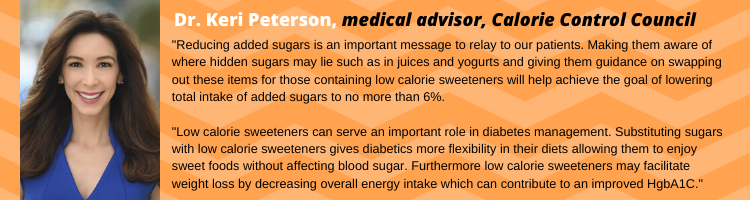
“As a primary care physician, I frequently provide dietary counseling to my patients who are diabetic, overweight or just want to live a healthier lifestyle. Substituting sugar sweetened beverages and snacks with low-calorie sweeteners is one of my tips,” said Keri Peterson, MD and medical advisor of the Calorie Control Council.



According to Robert Rankin, president of the Calorie Control Council, “Millions of Americans are affected by diabetes and obesity,. For these individuals, nutrition plays a major role in managing disease. Low and now calorie sweeteners are not a magic bullet but they are excellent tools to help reduce sugar intake, manage blood glucose levels, and reduce overall calorie intake.”

The following organizations have utilized the most rigorous and extensive testing methods to evaluate LNCS for use in diabetes management, and have concluded:

  • For some people with diabetes who are accustomed to sugar-sweetened products, non-nutritive sweeteners may be an acceptable substitute for nutritive sweeteners when consumed in moderation. – American Diabetes Association
  • Artificial sweeteners are also safe for people with diabetes when consumed within the ADI and the EFSA Panel concluded that there is sufficient scientific information to support the claims that intense sweeteners lead to lower postprandial blood glucose concentrations if consumed instead of sugars. For people who are accustomed to sugar sweetened products, nonnutritive sweeteners (NNS) have the potential to reduce overall energy and carbohydrate intake and may be preferred to sugar when consumed in moderation and can be a useful strategy for those individuals seeking to control their calorie and manage their weight. – Diabetes UK

For a half a century, The Calorie Control Council has been reviewing science on low calorie sweeteners and diet products. Established in 1966, the Council is an international association representing the low- and reduced-calorie food and beverage industry. Council staff includes experts certified in public health, food and nutrition. More at caloriecontrol.org.


faq2Do you have questions about low-calorie sweeteners? Want to learn more about maintaining a healthy lifestyle? You asked and we listened. Our resident Registered Dietitians answered the most popular questions about low-calorie sweeteners.

Media Contacts

For media inquiries please reach out to any of the below contacts: